TL;DR – Don't Compare Interior Design Quotes by the Final Number Alone
Two interior designers can quote very different amounts for the same home, and both quotes can be legitimate. The difference may come from the scope of work, furniture dimensions, material specifications, hardware, design process, execution methodology, site work, professional fees, exclusions and taxes.
Before choosing an interior designer, compare:
- Exactly what is included
- Design deliverables and number of revisions
- Dimensions and quantities of furniture
- Plywood/board and laminate specifications
- Hardware brands and specifications
- Paint and finish specifications
- Civil and electrical work
- Execution and supervision
- Third-party purchases
- GST, fees and other charges
- Items charged at actuals
- Timelines, warranties and exclusions
A “trustworthy interior design quote” isn’t necessarily the longest one, it is one that makes the basis of the price understandable. You should be able to read it and answer four basic questions:
- What am I getting?
- What specifications am I getting it in?
- What isn’t included?
- How can the price change later?
At New Leaf Designs, we believe a quote should give you enough clarity to understand what you are paying for, what is provisional, what is excluded and how the final cost will be developed.
Thinking about hiring an interior designer? Explore our interior design services to understand how we structure our engagements.
Why Do Interior Design Quotes Vary So Much for the Same Home?
If you have approached two or three interior designers for your home, you may have experienced something confusing: the quotes can be several lakhs apart even though you gave everyone the same floor plan.
That doesn’t automatically mean someone is overcharging.
It also doesn’t automatically mean the lowest quotation is a bargain.
The first thing homeowners need to understand is that an initial interior design quote is often a high-level budgetary estimate, particularly before the design, dimensions, materials and scope have been finalized.
Now, what actually causes the difference?
1. You're not necessarily comparing the same level of service
The first difference can be the type of firm you are approaching.
A team that primarily handles highly customized, design-intensive projects may have a very different process, team structure and fee model from a firm built around fast, standardized projects.
Each business model is inherently different. The important thing is understanding what kind of service you actually want. Always ask:
- How much design development is included?
- How many revisions are included?
- Are the layouts customised?
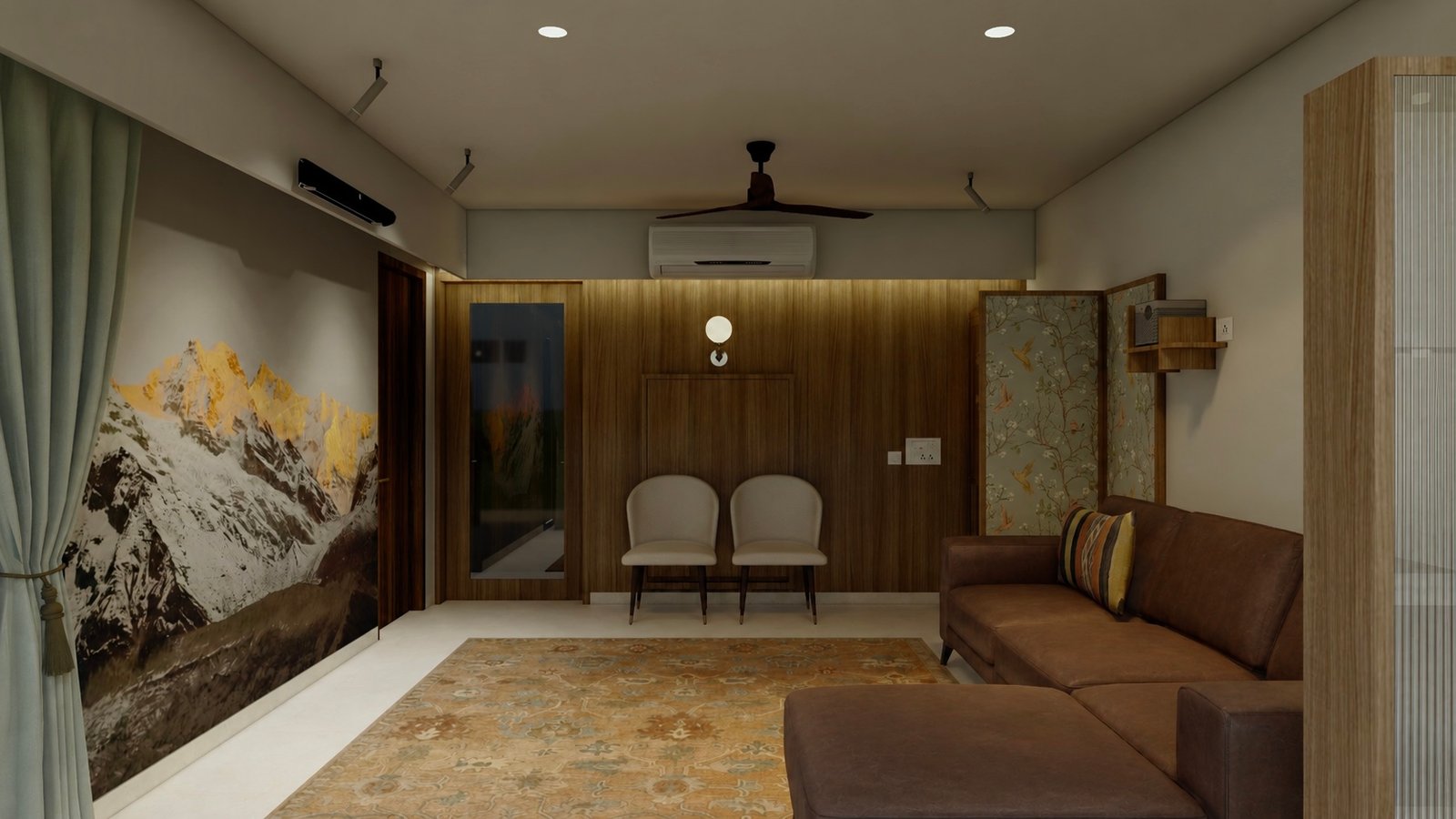
- How detailed are the 3D views?
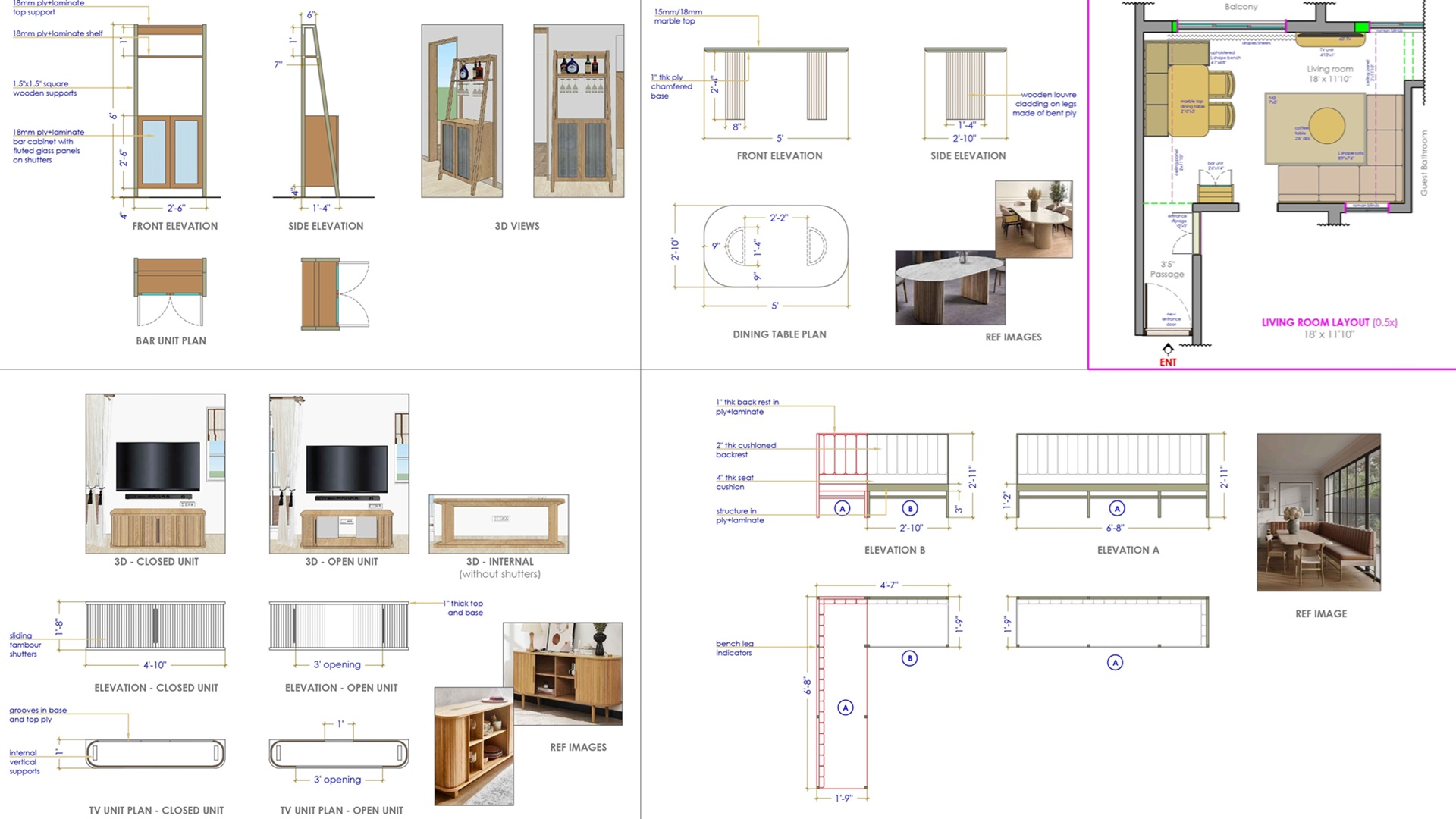
- Are technical drawings provided?
- Does the designer help with material selection?
- Is execution included?
- Is site supervision included?
- Who coordinates vendors and contractors?
These differences can have a substantial effect on the quotation.
2. Material specifications can change the price significantly
This is one of the biggest reasons an interior design quote that looks cheaper on paper may not actually be comparable.
Consider something as seemingly simple as a laminate. One quotation may allow for a lower-cost 0.8mm laminate, while another may specify a 1mm laminate from a particular brand and price range. The same applies to:
- MDF versus plywood
- Different grades of plywood
- Laminate thickness and brand
- Hardware brands
- Edge banding
- Paint grades
- Countertop materials
- Glass
- Finishing materials
- Lighting
- Accessories
A quotation that simply says “wardrobe – ₹X” doesn’t tell you enough. You need to know what wardrobe has been priced into that ₹X.
3. Furniture dimensions matter more than homeowners realise
This is an easy one to overlook.
Imagine one quotation estimates a wardrobe at 3 ft × 7 ft, while another estimates a wardrobe at 6 ft × 8 ft. Both may simply say “wardrobe” in the quotation, but they are not remotely the same quantity of work. The same applies to TV units, beds, study units, shoe storage, false ceilings, etc
This is why comparing two quotations purely on a per-square-foot basis can be misleading. Your home’s carpet area doesn’t tell how much furniture you want to build inside it.
4. Civil and electrical work can be treated very differently
Civil work is particularly difficult to estimate accurately before the site and design are finalised.
- One quotation might include an allowance for civil work.
- Another designer may state that demolition, plastering, plumbing modifications or other civil requirements will be charged at actuals.
That can make the second quote look cheaper initially. But the difference isn’t necessarily a pricing discrepancy. It may simply be a different way of handling uncertain site costs.
Electrical work is another major variable. The final requirement depends on your lighting plan, appliance locations, existing wiring, switches, additional points and other site-specific requirements.
The better question is: “How has uncertain work been treated in this quotation?”
NOT
“Why didn’t everyone give me the same number?”
5. The designer's fee and business model are part of the price
An interior design project isn’t priced only on plywood, laminates and labor. You’re also paying for the design process, project coordination, expertise, communication, procurement, supervision and the firm’s operating structure.
For example, New Leaf Designs’ interior design quote separates its typical fee structure into a design fee, site execution fee and sourcing fee, with additional charges potentially applying for services outside the agreed scope. That is very different from simply hiding every cost inside a single turnkey number.
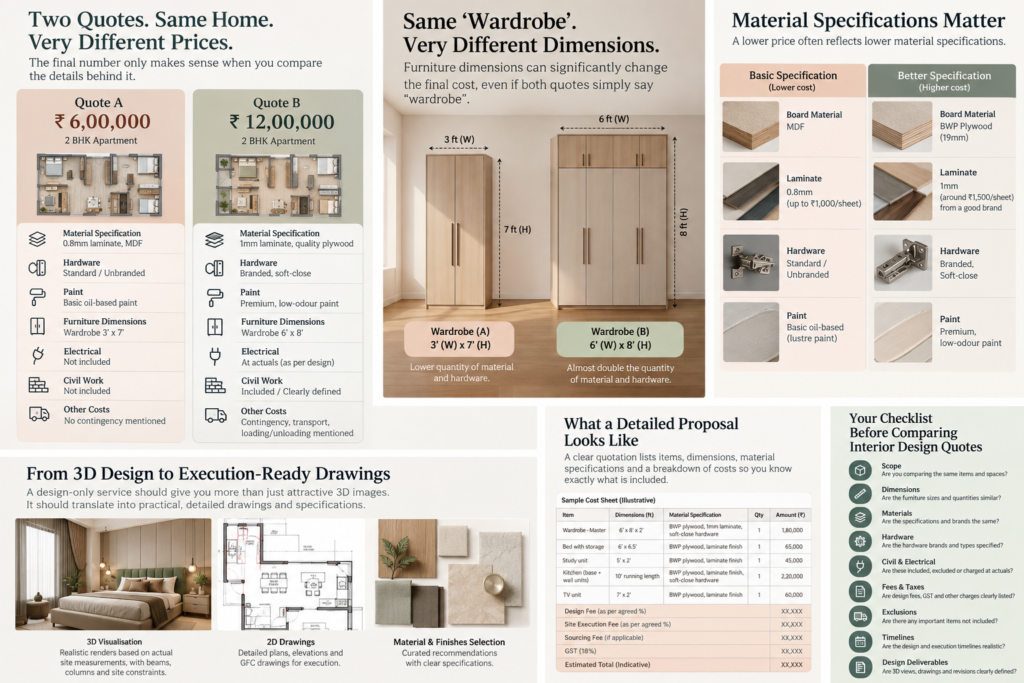
How to Compare Interior Design Quotes: What Should You Actually Look For?
Once you have multiple quotations, resist the temptation to put the three grand totals into a spreadsheet and circle the lowest number.
First make the quotations comparable.
A useful way to do this is to compare them under five broad headings.
1. Compare the scope
Start by asking what exactly is being designed and executed. Make a room-by-room list. This way, you may discover that the two designers weren’t actually quoting for the same scope of work.
2. Compare dimensions and quantities
Don’t just compare the number next to “wardrobe.” Compare:
Wardrobe: 6′ W × 8′ H × specified depth
VS
Wardrobe: 3′ W × 7′ H × specified depth.
The same principle applies throughout the home.
That’s useful because it allows the homeowner to understand what quantity of work the estimate is actually based on.
3. Compare material and hardware specifications
Don’t accept “Good quality plywood” or “Premium hardware” as a specification. Ask for the actual specification. For example:
- Board/plywood type
- Thickness
- Laminate thickness
- Laminate price allowance
- Hardware brand
- Hardware type
- Edge-banding specification
- Paint specification
- Countertop specification
- Glass specification
New Leaf Designs’ interior design quotation, for example, specifies laminate thickness, plywood types, edge-banding thickness and hardware rather than simply describing everything as “premium.”
This is one of the most important things to compare because a lower price may simply reflect a lower material specification.
4. Compare the design deliverables
This is especially important when you’re comparing a design-only service with another design-only service. For example, “3D design included” is not enough information. Instead ask:
- How many 3D views?
- Are they conceptual or realistic renders?
- Are they based on actual site measurements?
- Are beams and columns accounted for?
- Are furniture dimensions resolved?
- Are electrical and lighting layouts included?
- Are technical drawings provided?
- Are material selections included?
- Are GFC drawings included?
- How many revision rounds are included?
The objective is an execution-ready design package, rather than simply producing attractive images. This distinction matters particularly when comparing online interior design services.
A visually impressive 3D render isn’t necessarily a construction-ready design.
A useful related read is our guide to 2D and 3D interior design drawings and how they differ.
5. Compare the fees, taxes and exclusions
This is where many homeowners get surprised later. Check whether the quotation clearly identifies:
- Design fee
- Execution/supervision fee
- Sourcing charges
- GST
- Third-party purchases
- Transportation
- Loading/unloading
- Civil work
- Electrical fixtures
- Appliances
- Curtains
- Décor
- Deep cleaning
- Additional site visits
- Additional revisions
- Other site-specific expenses
A lower headline price can become considerably higher once excluded items are added.
This is also where our guide on hidden interior costs homeowners should watch for can help homeowners understand why the headline number isn’t always the final project outlay.
What Makes an Interior Design Quote or Proposal Trustworthy?
A trustworthy quotation isn’t necessarily the longest one. It is one that makes the basis of the price understandable. You should be able to read it and answer four basic questions:
- What am I getting?
- What specifications am I getting it in?
- What isn’t included?
- How can the price change later?
1. It should clearly define the scope
A proposal should reflect the actual conversation you’ve had with the designer. A well-developed interior design quote should also tell you what spaces and items have been considered.
2. It should distinguish between estimated and final costs
This is an important sign of transparency. A preliminary estimate cannot realistically predict every final cost before:
- layouts are finalised,
- furniture dimensions are resolved,
- materials are selected,
- site conditions are confirmed,
- and the scope is frozen.
So a good proposal should tell you which figures are indicative and which are firm. That is more useful than pretending an early-stage number is guaranteed.
3. It should clearly state what is charged at actuals
Some things genuinely cannot be accurately priced upfront. Civil work is a good example. Our proposal therefore states that certain work is to be charged at actuals, while also identifying other exclusions and potential variable costs.
The important thing isn’t whether everything has a fixed price on day one.
The important thing is whether you know which things don’t.
4. It should have proper material specifications
This is one of the biggest red flags if missing. A proposal should give you enough information to understand the material basis of the quote rather than simply saying “premium materials.” That level of specificity makes comparison possible.
5. It should explain the fee structure
Don’t be uncomfortable asking:
- “Exactly what percentage or fee am I paying for design?”
- “What is the execution/supervision fee?”
- “Is there a sourcing fee?”
- “What attracts GST?”
- “Are third-party purchases handled differently?”
Transparency around fees is much more useful than trying to hide every component inside a single attractive-looking number.
6. It should explain timelines and revisions
A trustworthy proposal should tell you what the design process actually looks like.
New Leaf’s Design + Build proposal, for example, gives an approximate design-development timeline and build timeline, while its terms explain how revisions and external delays are handled.
Similarly, the design-only proposal specifies an approximate design-development timeline and explains its revision limits. This matters because “design included” doesn’t tell you how much design work is actually included.
Red flags to watch for in an interior design quotation
There is no single number that automatically tells you a quote is bad. But there are some things worth questioning. Be cautious when:
The quotation doesn't mention dimensions
You can’t properly assess quantities without knowing what has actually been estimated.
Materials aren't specified in the quote
“Premium plywood” or “good quality hardware” isn’t a meaningful comparison specification.
Hardware is completely unspecified. Ask what brand and type of hinges, channels, lifts and other mechanisms are included.
The timeline appears unrealistically short
Ask what stages are included and what the timeline is based on.
The quotation is unrealistically low
Ask what has been excluded or what specifications have been assumed.
GST or other charges aren't clearly addressed
A pre-tax and post-tax number are not directly comparable.
Civil/electrical work is vague
Find out whether it is included, budgeted, excluded or charged at actuals.
There is no clear revision or design-process information
“3D design included” doesn’t tell you how much design development you’ll receive.
The proposal has no meaningful exclusions
If a preliminary quotation claims to include absolutely everything without explaining assumptions, ask how uncertain site costs have been accounted for.
Don't Compare Two Interior Design Quotes Until They’re Based on the Same Criteria
One of the biggest lessons from years of working on residential interiors is that you shouldn’t compare two homes simply because they have the same carpet area. Two 1,000 sq ft homes can require completely different amounts of:
- Storage
- Carpentry
- Electrical work
- Civil work
- Custom furniture
- Lighting
- Styling
- Design development
- Site supervision
Likewise, don’t compare a contractor’s quotation with an interior designer’s quotation and expect the numbers to represent the same service.
A contractor may be quoting primarily for execution.
A design studio may be charging for the design development, drawings, material selection, coordination and execution management that happen before and alongside the physical work.
And if you’re comparing designers, compare similar types of designers and similar engagement models. The question should always be,
“Which proposal is actually closest to the scope, quality, service level and design approach I want?”
What Should You Check Before Signing an Interior Design Proposal?
Before you sign, we would suggest checking four things.
1. Budget alignment
- Is the proposed budget realistically aligned with what you want?
- And do you have enough flexibility for reasonable changes or site-related variations?
2. Aesthetic alignment
Do you actually like the designer’s work? Not just one Instagram render but their overall design language.
3. Past-work alignment
A designer’s ability to create a ₹50 lakh home doesn’t necessarily tell you what working with them on a ₹15 lakh project will look like.
Look at completed work that resembles the type of home, budget and scope you’re considering.
4. Pricing and deliverable transparency
Before signing, you should understand:
- Scope
- Dimensions
- Materials
- Hardware
- Design deliverables
- Fees
- GST
- Exclusions
- Actual-cost items
- Timeline
- Revisions
- Payment schedule
- Warranty/after-sales terms
If you understand all of these, you’re in a much better position to make a meaningful comparison.
Before you make your final decision, we’ve put together a helpful guide to help you know what questions to ask an interior designer before hiring them.
The Bottom Line: Compare the Proposal, Not Just the Price
The biggest mistake homeowners make when comparing interior designers is treating the grand total as the product.
The grand total is simply the financial result of everything underneath it.
Don’t ask which quotation is cheaper. First understand what each quotation is actually buying you.
At New Leaf Designs, our approach is to make that process as transparent as possible; from defining the scope and developing the design to documenting specifications, deliverables, fees, exclusions and the assumptions behind preliminary pricing.
If you’re planning your home interiors and want to understand the different ways an interior designer can work with you, you can also explore our interior design services guide.
Ready to discuss your home?
Get in touch with New Leaf Designs to discuss your requirements, budget and project scope.