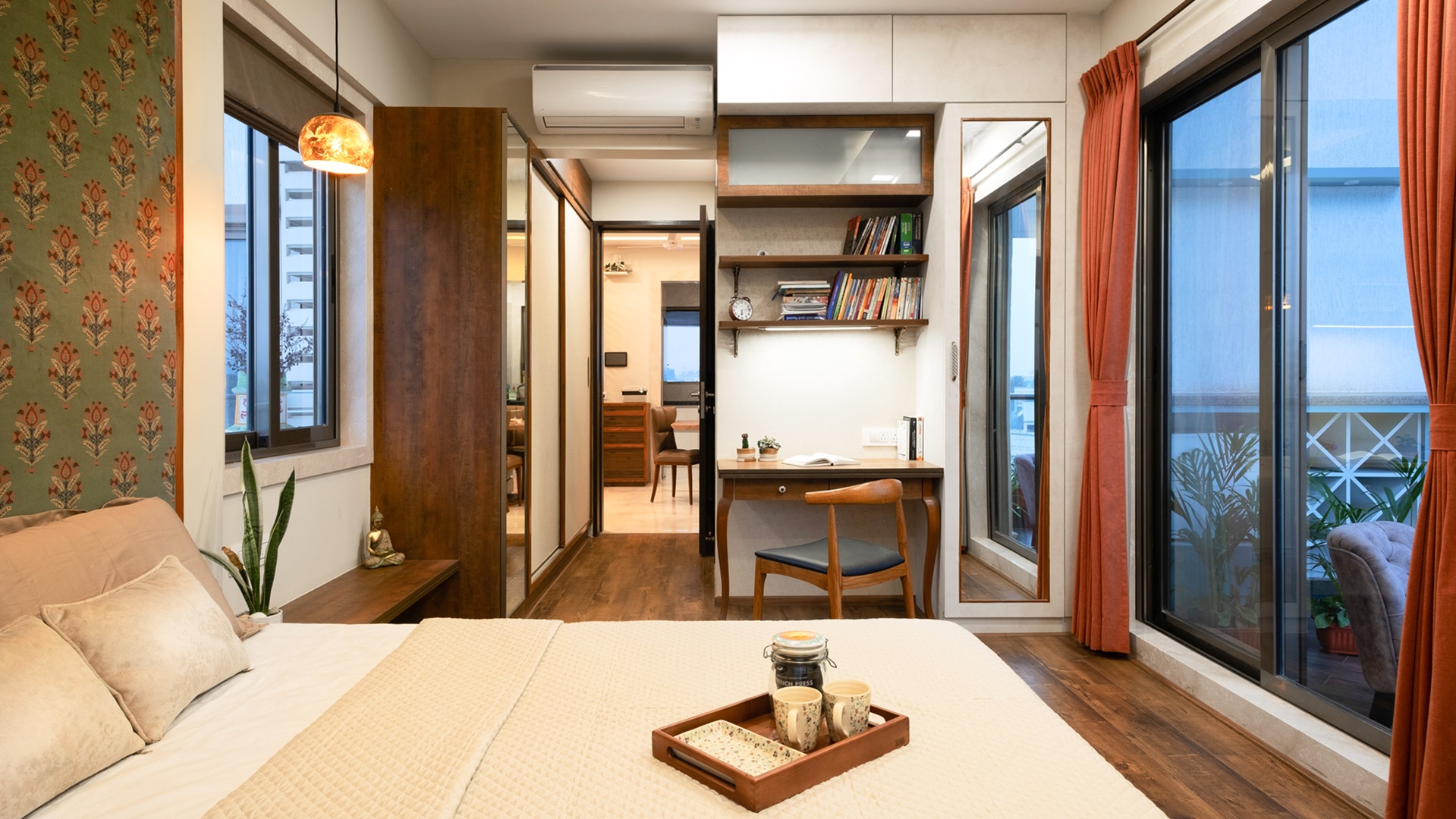
TL;DR: Interior Designer vs Contractor vs Carpenter
Hire a carpenter if you mainly need limited carpentry or furniture work. For example, refurbishing an existing wardrobe, adding a TV unit, upgrading hardware or making small pieces of furniture or straightforward furniture work for a new property.
Hire a contractor if the project is primarily execution-focused and involves multiple teams such as civil work, plumbing, electrical, painting, false ceiling and carpentry. Contractors are particularly useful for extensive renovation work and for bringing an already-developed design to life.
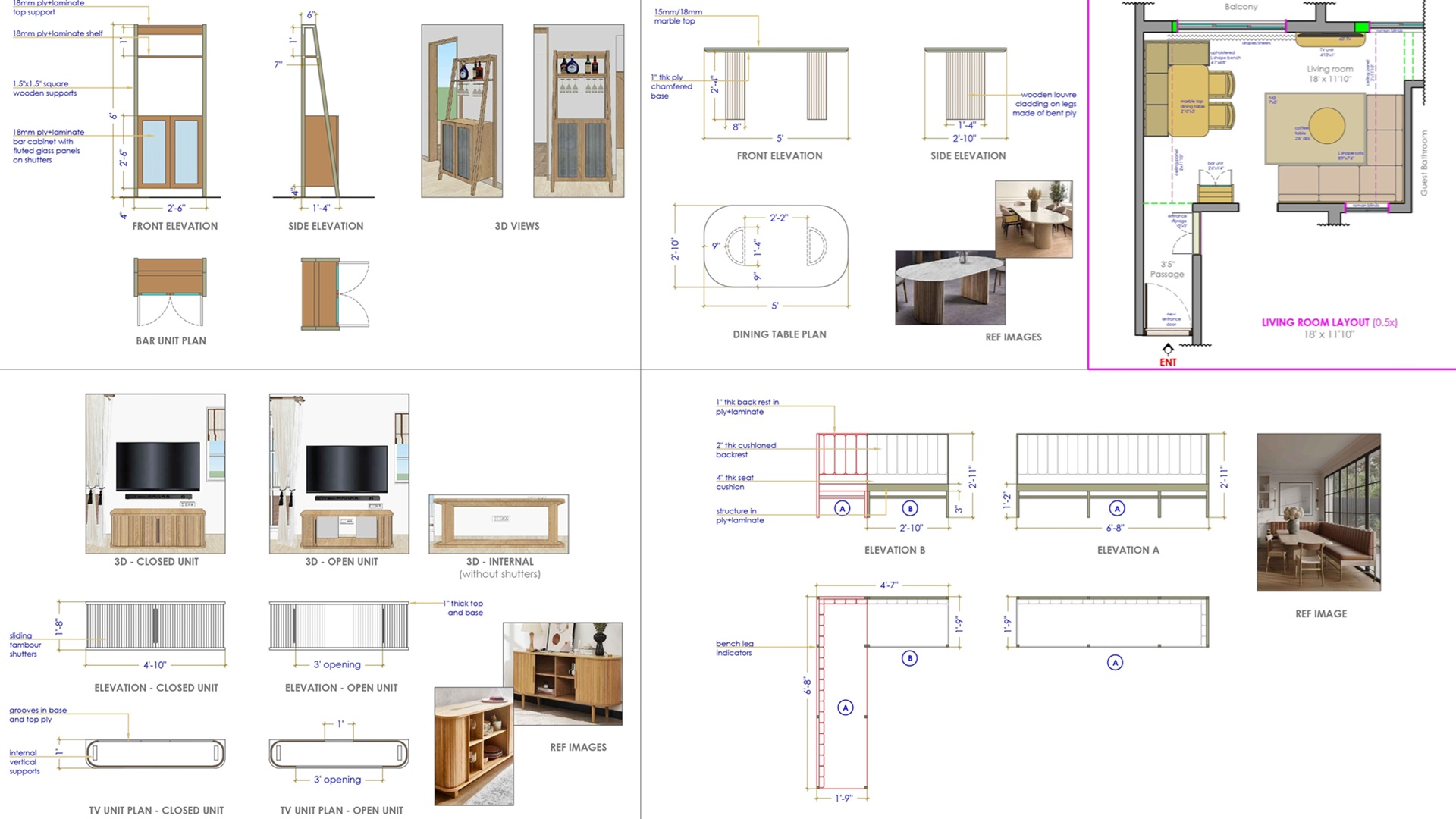
Hire an interior designer if you need help figuring out what to do with your home before you start executing it—space planning, visualisation, technical drawings, materials, furniture proportions, lighting, problem-solving and creating a cohesive design.
And you don’t necessarily have to choose only one!
For example, you can hire an interior designer for the design and a contractor for execution if you want professional design expertise while retaining more control over execution and sourcing.
Want help figuring out which approach suits your home?
Get in touch with New Leaf Designs
Interior Designer vs Contractor vs Carpenter: What's the Difference?
The biggest misconception we see is that homeowners assume these professionals are interchangeable. The way you approach and evaluate an interior designer should be different from the way you evaluate a contractor or carpenter because you are hiring them for different capabilities.
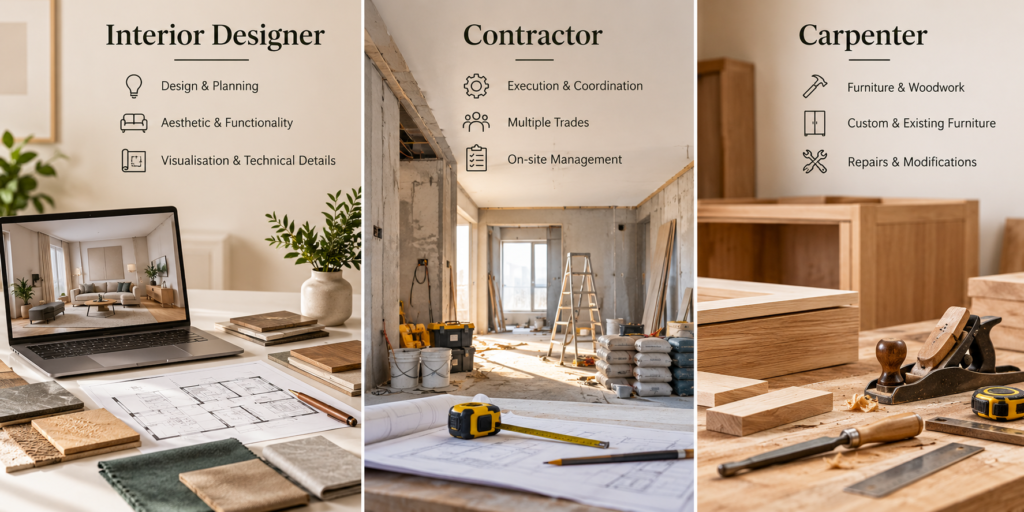
An interior designer is primarily responsible for the design thinking behind the space
This can include:
- Understanding your lifestyle and requirements
- Space planning
- Furniture planning and proportions
- Concept development
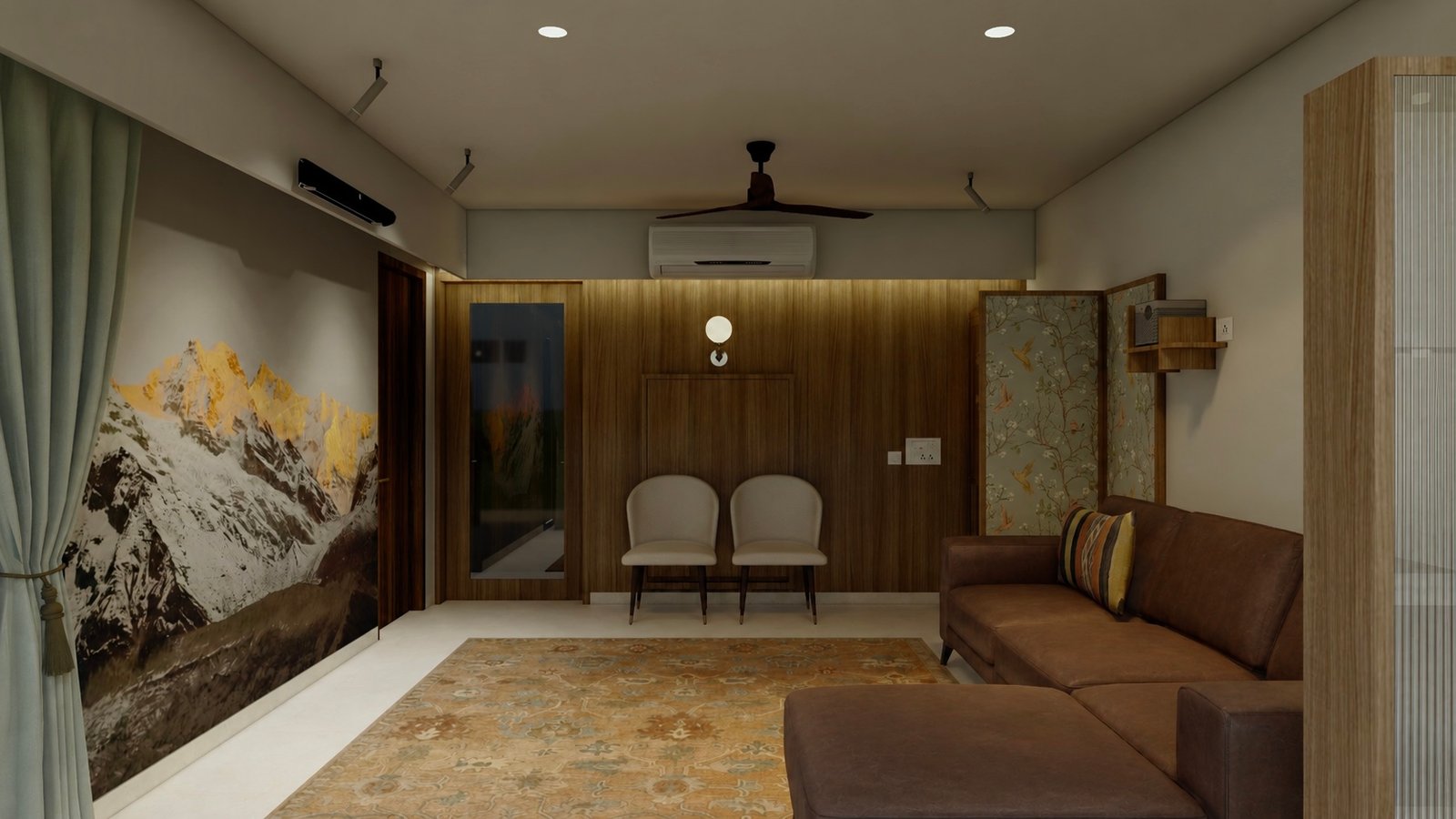
- 3D visualisation
- Material and finish selection
- Lighting and electrical planning
- Technical drawings
- Problem-solving
- Cost planning
- Design coordination
- Creating a cohesive aesthetic
If the designer also provides execution through a Design + Build model, their role extends into site execution, vendor coordination, material management and project management.
A contractor is primarily execution-focused
A contractor can bring multiple teams and vendors together under one umbrella and coordinate the physical work happening on site. Depending on the project, this could include:
- Civil work
- Plumbing
- Electrical work
- Painting
- False ceiling
- Carpentry
- Fabrication
- Masonry
- Other specialist trades
A contractor can therefore be extremely valuable when there is a lot of work happening simultaneously. But that doesn’t necessarily mean they will provide the design expertise needed to determine what should be built in the first place.
A carpenter primarily handles carpentry
A carpenter is often a subset of the larger execution process. In many projects, carpenters work under contractors or are hired directly for specific furniture-related jobs.
Since so much of a typical home interior involves furniture, homeowners sometimes assume that hiring a carpenter means they have effectively hired the person responsible for their entire interior.
But carpentry is only one part of a home interior. You may also need electricians, plumbers, painters, false ceiling teams, fabricators and other specialists. That’s why a carpenter can be perfectly appropriate for a limited furniture project but may not be the right person to coordinate an entire home renovation.
When Should You Hire a Carpenter?
A carpenter can be a very practical choice when your project is small, clearly defined and primarily about furniture or carpentry. A carpenter may make sense if you want to:
1. Refurbish existing furniture
For example, you may want to repair, modify or upgrade an existing wardrobe rather than replace it.
2. Add a few pieces of furniture
This could include a wardrobe, TV unit, console, wall panel, study unit, etc
3. Upgrade furniture hardware
Sometimes the furniture itself is perfectly usable but the hardware needs improvement. You may simply want to replace, hinges, drawer channels, handles, etc. This can extend the life of existing furniture without undertaking a complete renovation.
4. Do basic work in a rental home
If you’re working on a rental apartment or short-term rental and don’t want to make extensive changes, limited carpentry may be all you need.
5. Work within an existing layout
A carpenter can also make sense in a brand-new apartment where you are happy with the existing layout and don’t intend to make substantial changes to electrical points, ceiling, plumbing, flooring, etc. If different small works (such as electricals, painting, etc) can be completed independently without significant coordination, you may not need an entire contractor or design team.
When Should You Hire a Contractor?
When execution is the main challenge
This is especially true for older homes and extensive renovations. Imagine buying an old property that needs:
- Waterproofing
- Bathroom demolition and reconstruction
- Kitchen demolition
- Plumbing upgrades
- Electrical refurbishment
- Window or door upgrades
- Fabrication
- Roofing work
- Masonry or civil repairs
There may be several different teams working on the property, and coordinating them properly becomes a significant part of the job. A contractor can bring these different trades together and manage the execution process.
When you already have the design
- Already have a trusted contractor
- Have their own sourcing network
- Want more control over execution costs
- Want to purchase materials themselves
- Are comfortable being more involved in the project
- Want professional design expertise without handing over the entire execution process
When Should You Hire an Interior Designer?
If you're completely confused about where to start
This is extremely common for first-time homeowners. You may have a floor plan, a budget and hundreds of Pinterest or Instagram references, but still have no idea:
- Where to put storage
- How large the furniture should be
- Where electrical points should go
- What lighting you need
- Which materials are appropriate
- How much carpentry you actually need
- How to make the rooms feel cohesive
This is where design expertise becomes valuable.
You need to visualize the space before execution
An interior designer can help you see and resolve the idea before it gets built through layouts, drawings, material selections and accurate and execution-ready 3D visualizations. This can reveal problems while they’re still inexpensive to fix.
You have space-planning challenges
This becomes particularly important in compact apartments. Furniture that is too large or poorly positioned storage, can restrict circulation and make everyday tasks frustrating.
A kitchen can technically contain all the required cabinets and appliances while still being uncomfortable to use. Good design is about resolving these problems before execution.
You need technical expertise
Some homes involve more complicated design requirements, such as:
- Automation
- Complex electrical planning
- Unusual spatial constraints
- Difficult structural conditions
- Custom furniture
- Detailed lighting requirements
- Integrated storage
- Special material applications
These are situations where technical drawings and design development can make a significant difference.
You care strongly about the final aesthetic
If you have a specific aesthetic you want to achieve, whether that’s Scandinavian, contemporary, minimal, traditional or something more individual, the design decisions need to work together. That includes:
- Furniture proportions
- Colours
- Lighting
- Wall treatments
- Soft furnishings
- Décor
- Art
- Accessories
This is where styling and décor become part of the design rather than an afterthought.
A Real Case Study: When the Cheaper Option Becomes More Expensive
A recent 4BHK project inquiry illustrates why the lowest initial budget isn’t always the lowest overall cost.
The clients approached New Leaf Designs with a clear vision for a “minimal Scandinavian interior”. They wanted:
- Clean lines
- Clutter-free spaces
- Subtle finishes
- Restrained detailing
- A sophisticated but understated aesthetic
We estimated a ballpark budget of approximately ₹22–25 lakhs.
The important point was that the design looked simple, but achieving that simplicity required careful planning and precise execution.
Minimal interiors often leave very little room for mistakes because there are fewer decorative elements to hide poor proportions, awkward details or mismatched materials.
The clients felt the proposed budget was higher than they wanted to spend and decided to proceed with a carpenter instead.
Eventually, their total expenditure crossed ₹27 lakhs.
They later approached us for corrective design advice when problems started emerging. Some of the issues included:
- Handle-less matte kitchen cabinets that showed fingerprints constantly and were impractical for their cooking habits
- An overmount kitchen sink
- An incorrectly sized chimney
- A TV unit that began pulling away from the wall
- Restricted movement because of poor space planning
- An awkward seating arrangement
- An oddly placed breakfast counter that was just not being used as intended
The home had also failed to achieve the intended Scandinavian aesthetic because the materials, proportions and detailing didn’t support the original design direction.
The clients were now facing an estimated ₹3–4 lakh of additional partial rework, along with significant time loss.
How Much Does It Cost to Hire a Carpenter, Contractor or Interior Designer?
Carpenter: pay for execution only
The design-thinking responsibility lies with the homeowner. Carpenters may work on 2 formats:
- Labor-only arrangements
- Labor + material arrangements
With labor-only carpentry, you have greater control over which materials you purchase as per your design inspirations. But that also means you need to understand those materials well enough to make informed decisions.
If the carpenter supplies the materials, sourcing becomes easier for you, but you still need to understand what materials are actually being used. This can be a cost-effective option for straightforward carpentry work.
Contractor: pay for execution and coordination
A contractor may coordinate multiple vendors and trades and generally takes responsibility for managing the work on site. This saves the homeowner considerable time. However, contractor-led projects can still require homeowner involvement in:
- Material selection
- Design decisions
- Aesthetic decisions
- Checking material usage
- Monitoring timelines
- Resolving design-related questions
Contractor margins also include the cost of coordinating multiple vendors and teams.
Interior designer + execution (Turnkey project): you're paying for more than physical work
With an interior design with execution build model, your investment includes the design and execution ecosystem around the project. You’re paying for things such as:
- Design development
- Space planning
- Visualisation
- Technical drawings
- Material expertise
- Design problem-solving
- Selections
- Vendor coordination
- Site management
- Execution
- Project management
This means it isn’t useful to compare a turnkey interior design proposal directly against a carpenter’s labor quote. They aren’t selling you the same thing.
Design-only + contractor: another way to structure the project
You can also separate the two. A professional interior designer can develop the design, technical drawings, material specifications and execution documentation, while you appoint your own contractor. This gives you greater control over execution and sourcing while still giving you access to professional design expertise.
If you’re considering this approach, our case study on designing your home with your own contractor shows how a design-only interior consultation can work in practice.
Interior design doesn’t have to mean handing over your entire project. Depending on your needs, design and execution can be handled by the same team, or deliberately separated.
Before choosing an Interior Designer, Contractor or Carpenter, ask the following questions
1. Is this a new home or an old property?
An old property with extensive civil, plumbing or electrical work may require a contractor and multiple specialist teams.
2. How much renovation is involved?
Are you simply adding furniture, or are you demolishing kitchens and bathrooms, changing plumbing and electrical systems, modifying ceilings and undertaking other civil work?
3. Do you need help visualizing the space?
If you want to see layouts, furniture proportions, materials and 3D views before construction, design expertise becomes more important.
4. Does the space have unusual problems?
Complicated layouts, automation, structural constraints or specialised requirements can benefit from professional design and technical problem-solving.
5. What is the actual scope of work?
A ₹15–20 lakh budget doesn’t tell you enough by itself. A 3BHK with minimal carpentry is very different from a 3BHK requiring extensive storage, civil work, electrical modifications, custom furniture, lighting and styling.
6. How involved do you want to be?
Do you want to personally:
- Source materials?
- Coordinate vendors?
- Supervise work?
- Check measurements?
- Resolve site problems?
- Make design decisions?
Or would you rather have someone manage most of this for you?
7. How important is the final aesthetic?
If your goal is simply functionality, a contractor-led project may be sufficient.
If you’re trying to achieve a specific aesthetic with carefully coordinated materials, furniture, lighting and décor, design expertise becomes much more important.
8. Have you worked with a contractor or carpenter before?
If you’ve managed a renovation before and already have trusted vendors, a design-only approach may be worth considering. If you’ve never managed a home project, the coordination involved can be substantial.
9. Does your budget align with your expectations?
Be realistic about what you want to achieve. A highly detailed design, extensive custom furniture, premium materials, styling and complete project management all require resources. The design brief, budget and execution model need to align.
10. Do you need styling and décor assistance?
Ask yourself whether you want help with the elements that make the finished home feel complete:
- Lighting fixtures
- Rugs
- Curtains
- Artwork
- Wallpaper
- Coffee tables
- Soft furnishings
- Accessories
If yes, make sure the professional you hire actually provides this as part of their scope.
What If You Need More Than One?
In reality, many successful home projects involve all three at different stages. For example:
Interior designer → develops the design and technical drawings
↓
Contractor → coordinates the execution and multiple trades
↓
Carpenter → executes the carpentry work on site
This is completely normal.
The problem arises when you expect one professional to perform responsibilities that they were never hired or equipped to handle.
Final Takeaway: Hire for the Problem You Need Solved
Choosing between an interior designer, contractor and carpenter isn’t really about finding the cheapest person. It’s about understanding the job.
- If you need a wardrobe modified, a carpenter may be exactly what you need.
- If you have an old property requiring extensive civil work and multiple trades, a contractor may be essential.
- If you’re struggling to understand how your entire home should function, look, flow and come together, and you want those decisions resolved before execution, an interior designer can bring a very different kind of value.
- And if you want professional design but already have a trusted contractor, you don’t necessarily have to choose between design and execution. A design-only interior consultation can give you the professional planning, drawings, visualization and technical expertise while allowing you to manage execution yourself.
If you’re still unsure which type of interior design service makes sense for your home, explore our interior design services guide to understand the different ways you can work with an interior designer.
OR
Get in touch with New Leaf Designs and we’ll guide you with the right approach.
FAQs
Is it cheaper to hire a carpenter or an interior designer?
A carpenter-only approach can be cheaper when the project is limited to straightforward carpentry or furniture work. However, the two options aren’t directly comparable because an interior designer provides design development, planning, technical expertise and other services that a carpenter may not provide.
The right comparison depends on the scope of your project and what responsibilities you want to take on yourself.
Can I hire a contractor without an interior designer?
Yes. A contractor can be appropriate when the project is primarily execution-focused, particularly if you already know what you want or have an existing design.
However, if the project requires detailed space planning, visualisation, technical drawings, material selection or significant design problem-solving, you may benefit from involving an interior designer.
Can an interior designer work with my own contractor?
Yes. A design-only interior design service can be structured specifically for this arrangement. The designer develops the design and documentation, while your contractor handles execution. This can be useful if you already have a contractor you trust or want greater control over sourcing and execution.
Should I hire a carpenter directly for my kitchen?
It depends on the complexity of the project and how much design input you need.
If you’re simply replacing or modifying an existing kitchen with a straightforward scope, a carpenter may be sufficient.
If you’re designing a new kitchen, however, there are many decisions to resolve, including appliance planning, storage, counter heights, hardware, lighting, materials and circulation. Professional design input can help address these before construction.
Who should I hire for a complete 2BHK or 3BHK interior?
For a complete home interior project, the answer depends on the scope, your budget, how much renovation is required and how involved you want to be.
If you need extensive design development and execution management, an interior designer with an execution team may be appropriate.
If you already have a trusted contractor and mainly need professional design expertise, a design-only service combined with your contractor can be another option.
Is a contractor the same as an interior designer?
No. While there can be some overlap, their primary responsibilities are different.
An interior designer focuses on planning, design, visualisation, technical development, materials and problem-solving. A contractor primarily focuses on executing and coordinating the physical work on site.
What does an interior designer do that a contractor doesn't?
Depending on the service, an interior designer may provide space planning, concept development, 3D visualisation, material selection, furniture planning, lighting and electrical planning, technical drawings and design problem-solving.
The exact scope varies by firm, so homeowners should always check the proposal and deliverables before hiring.